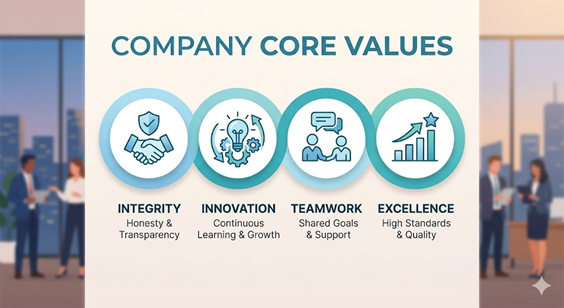
In my last post, we looked at the scoreboard: KPIs and Reporting. But if your strategy is the map and your KPIs are the speedometer, your Core Values are the guardrails.
Most organizations have values listed on their website or a plaque in the lobby. They tell stakeholders (investors, customers, and employees) what the company stands for. But the real question is: Do those values come to life in the workplace?
The Credibility Gap: There is often a massive gap between an organization’s “stated” values and its “lived” reality. When an organization claims to value “Teamwork” or “Safety” but only rewards the “lone wolf” or the “production-at-all-costs” manager, the values aren’t just hollow; they are a liability. This “Credibility Gap” erodes trust and undermines Organizational Effectiveness.
The Two-Part Performance Assessment: The most sophisticated organizations I work with at O Consulting have moved beyond the traditional “did you hit your number?” review. They assess performance in two distinct, weighted pieces:
- The “What” (Objectives & KPIs): Did you achieve the specific goals set out in the annual plan?
- The “How” (Lived Values): Did you achieve those goals in a way that aligns with our core values?
Values as a Performance Driver: When lived values are integrated into Pay-for-Performance structures or bonus calculations, the values suddenly have “teeth.” They aren’t just suggestions; they are requirements.
By assessing how people work together to achieve their objectives, you ensure that success isn’t built on the back of a toxic culture. You demonstrate, both internally to your employees and externally to your stakeholders, that you truly believe in the values you post about.
How I Help: At O Consulting, I help organizations move values from “wall art” to “behavioural expectations.” I work with leadership teams to design Performance Management Systems that measure both results and behaviours, ensuring your culture supports your strategy rather than sabotaging it.
Next up: Now that we have identified values as being key to organizational effectiveness, we will discuss how leaders can embed them with behaviours.