Most organizations have a “values problem,” but it isn’t what they think it is.
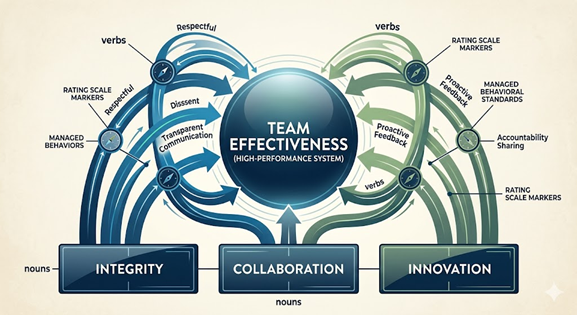
The problem isn’t that the values are wrong—Integrity, Collaboration, and Excellence are all great objectives. The problem is that these values are nouns. And in the daily pressure of a high-stakes environment, nouns are far too open to interpretation.
When we leave values open to interpretation, we create a vacuum. And in systems leadership, we know that vacuums are quickly filled by negative symbolism.
The Birth of Corporate Mythology
If a leader’s “walk” doesn’t match their “talk,” they inadvertently create symbols. An executive who touts “Transparency” but holds closed-door meetings about budget cuts is sending a symbolic message.
When these symbols go unaddressed, employees do what humans have done for millennia: they create mythologies. They tell stories in the breakrooms and private chats about “how things really work around here.” These stories are the primary reason many organisations see dismal “Trust in Leadership” scores on their annual engagement surveys.
The Social Operating System
We would never dream of running a technical process or a mining operation without a Standard Operating Procedure (SOP). Yet, we often expect teams to achieve “High Performance” without a Social Operating Procedure.
We focus on the technical mechanics of what gets done, while ignoring the social behaviours of how we show up for one another.
To bridge this gap, we must move from abstract values to Behavioural Mapping.
Mapping the “How”
A Behavioural Map is a tool that translates a value into a specific, observable verb. It takes the guesswork out of leadership and the mystery out of being a “team player.”
In my work with a key client, we took their defined values and distilled them into specific behavioural markers mapped directly to their Performance Management rating scale.
Why this is a gamechanger for team effectiveness:
- For Leaders: It provides an objective yardstick. Feedback is no longer “I feel like you aren’t collaborative”; it becomes “To move from a Level 2 to a Level 4 in Collaboration, we need to see you actively seeking input from junior team members.”
- For Team Members: It provides a growth roadmap. It empowers individuals to take agency over their own professional development by showing them exactly what “living the values” looks like in practice.
- For the System: It builds a culture of accountability. When behaviours are defined, measured, and role-modeled, the “negative symbols” lose their power.
From Map to Culture
Behavioural Mapping is the first step in ensuring team effectiveness. It creates the clarity needed for high-stakes collaboration.
But behaviours don’t exist in a vacuum. They are the building blocks of something much larger. As we move through April, I’ll be exploring how these individual maps eventually draw the blueprint for your entire organization.
Because if behaviours are the language of your team, Culture is the driver of effectiveness.
Does your leadership team have a Behavioural Map, or are you still navigating by a poster on the wall?
I help organisations make the “social aspect” of work tangible and objective. If you’re ready to bridge the Authenticity Gap in your leadership, let’s connect.